
Canoco 生態資料分析軟體 5.15
多變量生物分析軟體
Multivariate Analysis of Ecological Data

軟體代號:473
瀏覽次數:747


多人版
教育版
商業版
再啟動服務
遠端安裝啟動服務
原廠技術服務
永久授權
安裝序號
網路啟動
原廠光碟
合法保證
原廠手冊
64 Bit
影音教學檔


Features
Canoco 4.5 for Windows is now shipping! A full Windows version of the older DOS programCANOCO 3.1
A FORTRAN program for canonical community ordination by [partial] [detrended] [canonical] correspondence analysis, principal components analysis, and redundancy analysis.
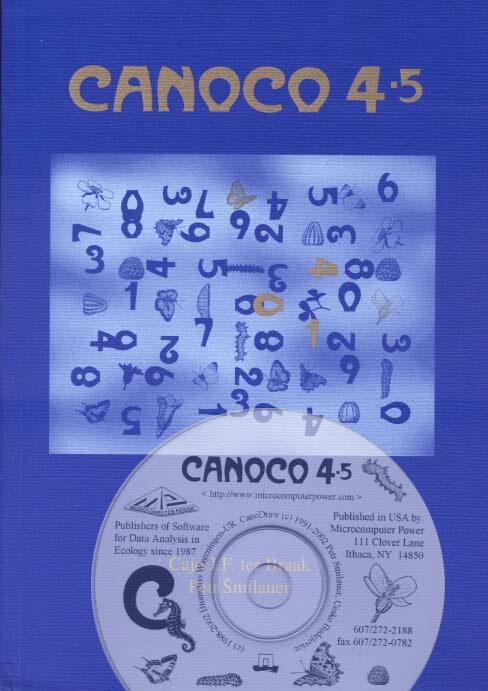
Canoco 4.5
by Cajo J.F. ter Braak of the Plant Research Institute (PRI), at Wageningen, The Netherlands.
Introduction on Canoco for Windows 4.5
Canoco for Windows is the next generation of CANOCO software, the most popular tool for constrained and unconstrained ordination in ecological applications. Canoco for Windows integrates ordination with regression and permutation methodology, so as to allow sound statistical modelling of ecological data. Canoco for Windows contains both linear and unimodal methods. Ordination with Canoco for Windows can provide insight into:
the structure of biological communities,
the relations between plant and animal communities and their environment,
the effects of a putative impact on the environment and/or its biological communities, and
the effects of treatments of complex ecological and ecotoxicological experiments on biological communities.
Ordination diagrams can be displayed on screen immediately after an ordination has been calculated. Canoco is unique in its capability to account for background variation specified by covariables and in its extensive facilities for permutation tests, including tests of interaction effects. These unique features make Canoco for Windows particularly effective in solving applied research problems.
Canoco has been designed for ecologists, but Canoco has also been used in toxicology, soil science, geology, public health research and market research, to name a few.
About the authors
The Canoco for Windows package has been developed by Cajo J.F. ter Braak and Petr Šmilauer.
Cajo J.F. ter Braak is a senior biometrician at the Biometris, Plant Research International BV, the Netherlands, with a specialization in multivariate methods for species-environment relationships. He is the inventor of canonical correspondence analysis, popularized (partial) redundancy analysis, and is co-author of the textbook Data Analysis in Community and Landscape Ecology. His inspiration for developing methods comes from collaboration with researchers from the DLO-Institute for Forestry and Nature Research and the DLO Winand Staring Centre for Integrated Land Soil and Water Research.
Petr Šmilauer is a plant ecologist at the Faculty of Biological Sciences, University of South Bohemia, Ceske Budejovice, Czech Republic. He works at the interface of computer science, modelling, and ecology. He is the author of CanoDraw for Windows and of the Windows specific elements of Canoco for Windows.
References
Jongman R. H. G., ter Braak, C. J. F. and van Tongeren, O. F. R., editors (1995). Data analysis in community and landscape ecology. Cambridge University Press, Cambridge.
ter Braak, C. J. F. (1986). Canonical correspondence analysis: a new eigenvector method for multivariate direct gradient analysis. Ecology, 67, 1167-1179.
ter Braak, C. J. F. (1994). Canonical community ordination. Part I: Basic theory and linear methods. Ecoscience, 1, 127-140.
ter Braak, C. J. F. (1996). Unimodal methods to relate species to environment. Centre for Biometry Wageningen (DLO Agricultural Mathematics Group), Wageningen, the Netherlands, 266 pp.
ter Braak, C. J. F. and Verdonschot, P. F. M. (1995). Canonical correspondence analysis and related multivariate methods in aquatic ecology. Aquatic Sciences, 57, 255-289.
ter Braak, C. J. F. and Looman, C. W. N. (1994). Biplots in reduced-rank regression. Biometrical Journal, 36, 983-1003.
ter Braak, C. J. F. and Šmilauer, P. (2002). CANOCO Reference Manual and CanoDraw for Windows User's Guide: Software for Canonical Community Ordination (version 4.5). Microcomputer Power (Ithaca NY, USA), 500 pp.
van den Brink, P. J. and ter Braak, C. J. F. (1998). Multivariate analysis of stress in experimental ecosystems by Principal Response Curves and similarity analysis. Aquatic Ecology, 32, 163-178.
Overview

| Canoco for Windows is the next generation of Canoco software, the most popular tool for constrained and unconstrained ordination in ecological applications. Canoco for Windows integrates ordination with regression and permutation methodology, so as to allow sound statistical modelling of ecological data. Canoco for Windows contains both linear and unimodal methods. Ordination with Canoco for Windows can provide insight into: |
- the structure of biological communities,
- the relations between plant and animal communities and their environment,
- the effects of a putative impact on the environment and/or its biological communities,
- the effects of treatments of complex ecological and ecotoxicological experiments on biological communities.
Ordination diagrams can be displayed on screen immediately after an ordination has been calculated. Canoco is unique in its capability to account for background variation specified by covariables and in its extensive facilities for permutation tests, including tests of interaction effects. These unique features make Canoco for Windows particularly effective in solving applied research problems.
Canoco has been designed for ecologists, but Canoco has also been used in toxicology, soil science, geology, archeaology, water district management, food and health and public health research and market research, to name a few.
SnapShot
flier01
光碟
手冊1
手冊2
---
Academia Sinica Research Center for Biodiversity, Academia Sinica
National Chung Hsing University Department of Soil and Environmental Sciences
National Taiwan University Graduate Institute of Environmental Engineering
National Taiwan University Department of Bioenvironmental Systems Engineering
National Kaohsiung Normal University Department of Bioscience Technology
Tajen University
National Chung Hsing University Department of Soil and Environmental Sciences
National Taiwan University Graduate Institute of Environmental Engineering
National Taiwan University Department of Bioenvironmental Systems Engineering
National Kaohsiung Normal University Department of Bioscience Technology
Tajen University
